Showing posts with label residential care. Show all posts

Saturday, 22 August 2015

My Biggest Lie: Part 2

It was the summer of 2011. After many years of struggle, I had finally accepted that mum’s dementia had progressed to a stage where I could no longer keep her safe at home; encouraged by the social worker, I had found her a residential place. But as mum believed there was nothing at all wrong with her, how could I persuade her to move?

I had spent the August Bank Holiday with her at our family home as usual, but had returned to London to make the final arrangements. This might seem odd, given that the care home was in mum’s town; but I could not visit it openly (or indeed go out by myself at all, except briefly to the shops), neither could I use the computer or phone in mum’s presence, because, if I were out of sight for even a moment, she would come looking for me, and would interpret any outside communication as suspicious. She’d had paranoid symptoms for years; it was a horrible irony that I was now really plotting behind her back.

I needed to wait a few days to speak to the unit manager at the home, who was away on holiday. I was also waiting for the psychiatrist to return, in order to assess mum’s mental capacity for my Court of Protection Deputyship application. This would give me legal authority to manage her finances, which I would need to pay the care fees. The psychiatrist and I had agreed that I would always stay away when she visited, so that she could see how mum was on her own, and so that I would not be associated in mum’s mind with any unwelcome professional approaches. She would usually visit with Jenny, the independent care-worker mum liked, in order to maintain her trust.

A couple of days before this visit was due, I was disturbed to receive a phone call from an old friend of mum’s, whom she had not seen for a while. This friend told me that mum had rung her out of the blue, and said some very strange and upsetting things. She did not go into detail, but the fact that I never heard from her again, despite continuing to send Christmas cards, good wishes, and letters of explanation, suggests that it must have been something extremely offensive. 

The psychiatrist’s visit passed apparently without incident, although she did call me at the time to ask some background details, such as whether our dog and various relatives were dead; as so often the case, mum presented well verbally and socially, but what she said and believed was highly delusional – something you would only know by checking the facts.

I was reasonably assured that all was proceeding to plan. The next day, Jenny reported that she had looked in on mum and supervised her eating an early supper, so I felt it was safe to go out for a few hours with friends. Little did I know that mum’s symptoms had been building to an acute psychotic episode…

It was on my way home that I received a call from her Aid-Call alarm service, asking me to ring the police, who were at our house. At the time, all they could tell me was that some neighbours had found mum in distress and called the police to take her home. It was not until later in the week that I learned the full story. 

Desperate to find someone to stay with mum until I could get there, I rang round her close friends and next-door neighbours, who had often helped us in crisis – but they were all away. Social services out of hours were also unable to help, and I could not contemplate sending her anywhere alone in an ambulance. 

By this time, it was nearly midnight and I knew I was over the alcohol driving limit, but even so, I would have set off there and then, had I not needed to speak to the care home manager the next morning, when she was due back. I knew that once I returned to mum’s, all verbal communications would be impossible.

I shall never forget the despair of that night, lying awake waiting for daylight, fearful that mum might go out again in my absence and come to grief. In the morning, as soon as I had spoken to the care manager, I set off, stopping at the petrol station to stock up on food, as I would not be able to leave mum to go out shopping unless someone could sit with her.

En route, I also spoke to the social worker and updated her on events. When I arrived, I found all the curtains drawn, every light in the house blazing. In the living room, a cold cup of tea and plate of toast that I had asked the kind policemen to prepare the night before stood untouched on a side table. There was no response to my arrival. 

I found mum upstairs in bed, totally inert. Momentarily alarmed that she might actually be unconscious, I woke her. She looked at me with no curiosity, as if nothing had happened and I had been there all along.

For the rest of that week until the date of her admission to the home, we were both prisoners in the house. I had arranged for Jenny to come and sit with mum, while I went “to the shops” – in reality, an appointment at the care home, to go through paperwork with the manager. It was a nauseatingly stressful round-trip of a couple of hours, culminating in a frantic “supermarket sweep”, as I had to return with goods to support my cover story.

As the days ticked by, tension mounted. How, how could I ever raise the subject of the impending move with mum? Slipping out for another supermarket trip (covered by the next-door neighbour), I called the home from the car park. The room, they confirmed, would be vacant in a couple of days; ready when you are.  Amid the groceries, I had stashed away toiletries and make-up for mum’s sponge bag; it seemed so pitifully underhand and final. I broke down and sobbed in my car, as boisterous children scooted by on trolleys and mothers loaded their weekly shop. I have lost count of the car-parks and lay-bys I have now wept in.

So how did I do it?  What did I say?  In the end, it was mum who raised it first. Watching TV in silence, she suddenly turned to me and said: “What’s going to happen to me?”  It was a heart-stopping moment.  How did she know?  What did she know? It seemed that somehow, despite having no reasoned knowledge of the situation, she sensed that she was in crisis and that something was afoot.  How could I answer?  I had never lied to her, but neither could I explain the full truth. 

“I think you need to go somewhere, where you can have people around you”, I said.  “People to keep you company when I’m not here and look after you at night, when you get frightened.”  “I don’t get frightened”, she said, despite having repeatedly told me that she was, without ever really knowing why.  Miraculously, we managed to have a tentative discussion along these lines and she didn’t go berserk at me, as I had feared for so long - although there remained an uncomfortable silence at the end. I was hugely relieved to have it out in the open at last.  And yet… 

By the time I had put the kettle on to make a restorative cup of tea, the whole tortuous conversation had of course been forgotten. I would have to broach it again the next day – the very day of the move.

That night, as I lay curled up, weeping, in my bed, mum opened the door and looked at me, strangely dispassionate, more bemused than upset.  “What’s the matter?”, she asked.  “Why are you crying?”  What could I say?  That this was our last night together in our own home?  The house we had moved into in Christmas 1973, when it was new and my father was still alive?  Her last night in the outside world?  The beginning of the end of a relationship that had started with my birth? 

Impatient at my inability to respond, she chided: “Now come on! Stop that.”  Then: “I love you, you know. As if you were my own daughter.” As if? Then who did she think I was?  Were we strangers already?

On the day of the move, I surreptitiously packed an overnight bag, as instructed by the manager - best not to take too many things at once, you can bring in more once she’s settled – and put it ready in the back of the car. Mum came downstairs at lunchtime; I made us something to eat.

I had forwarded her “life story” information (material facts, key events, likes and dislikes) to the home from my phone, filling in the form in my bed overnight. Far from ideal, but the best that I could manage in the circumstances.  I had emailed the social worker to ask if she could stand by to come with me if needed, but she had to be in a meeting that day. All that remained was to get mum into the car.

After lunch, we sat in silence, while I steeled myself to come out with it.  And once again, mum took the lead.  “What are we doing?”, she asked.  “We’re going to look at this place”, I replied.  “What place?”  “A place for you to stay in the week, when I’m not here.  Where they can take care of you…  Shall we go then?  Just have a look?  We can have a cup of tea…?”

And that was my biggest lie.  The only way I knew, to do what had to be done.  “Just a look… Just a cup of tea…”  When I knew it was forever.

She let me zip her into her jacket and got into the car.  The staff, from the manager to the receptionist and finance controller, had been primed to greet her as a visiting guest for tea.  I took her upstairs to the unit at tea-time, and, as instructed by the manager, waited for her to be distracted in conversation, and slipped out quickly without any fuss.  Just like a mother, taking a little child for her first day at school.

A move into residential care is at least as much a watershed for the family carer, as for the person with dementia – and the grief arguably greater, for we know the full story of loss. No-one does this lightly.  One might consider it similar to abortion: a choice you make when it has become the only viable option. A similar stigma, maybe.

To carers, I say it may seem an impossible decision, an overwhelming task.  But sometimes you have to face it and you can survive.

To parents, I say please, please don’t elicit impossible promises from your children; have the courage to confront your own mortality before you lose capacity; have the discussions while you can, be realistic, draw up power of attorney, put some plans of your own in place.

To everyone: don't fear care homes.  The sector is woefully underfunded and undervalued, yes; there are bad homes, true.  But there are also many good ones and wonderful people doing essential work to support the most vulnerable in society.  Don’t let’s stigmatise them. It is not a fate worse than death.

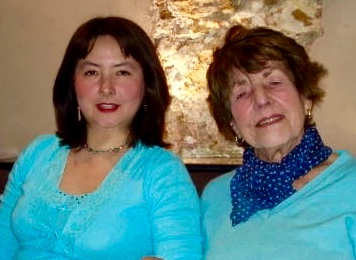
Here are mum and I, as I prefer to remember us, about twenty years ago, outside our home, now sold to pay mum's fees. (Not, by the way, a “mansion”, as so often assumed of those liable for 100% self-funded care at circa £1,000 per week, just an ordinary suburban house.)

So if anyone thinks it’s easy to “put your mother in a home”, read this back. Imagine all those lonely years, when I had dreaded having to break mum’s trust in me, her only child.  I did it to save her. She is still alive today. I have no-one left. 

It will be a long time, if ever, before I can think of August as a happy holiday season.


(This two-part post - read part one here - is a companion piece to an earlier post concerning the issue of "truth-telling" in dementia care.)

Sunday, 18 May 2014

Not the Beige Cardigan

Dementia Action Alliance Carers' Call to Action* was a UK campaign that aimed to highlight the particular needs of dementia carers and recognise their rights; I was a member. Along with a number of other family carers, I was invited to speak at the 2014 Alzheimer's Show at the Olympia in London and share my personal story to illustrate the need for the five key aims to be met. 

So why do dementia carers need special recognition? Because, despite much greater awareness of dementia in the media, there remains widespread lack of understanding that it’s not just a bit of dotty forgetfulness, but a degenerative, cognitive disorder that can have all-consuming long-term consequences, not just for the person who experiences it first-hand, but also for the family carer.

Below is the edited text of my Alzheimer’s Show talk of 16 May 2014.  It covers some common ground with previous posts, but was aimed at a general audience at the Show; if you’re a new reader, you can find more detailed accounts of some of the stories and issues via links to my archive.  (And lest anyone think this means I’ve got it sussed, see my next post, I Don't Know Who You Are…)

Some of you may know me as @Minghowriter on Twitter.  I am a professional writer; I’ve written scripts for TV shows such as EastEnders and Casualty, and I’ve worked behind the scenes in drama production.  

But I’m here today because my mum, Glenys, who’s 87, has mixed Alzheimer’s and vascular dementia. It’s been a long journey – more than a decade of pronounced symptoms and much longer since the earliest signs. We’ve both lived with dementia for the best part of twenty years.

Mum’s now in residential care, where she’s been since September 2011. By that stage we were both at breaking point. 


A bit of background: I’m an only child.  My dad died in 1988, when I was a student; it’s been just mum and me since then.  She was an only child too; we have no other immediate family. I moved to London when I graduated, to find work 100 miles away from my hometown. 

Looking back, I think the shock of my father's death and my leaving home at around the same time triggered early symptoms of dementia: separation anxiety and disproportionate emotional responses to certain situations. So I'd say beware of traumatic life events - bereavement, accident, moving house, divorce - and don't ignore any warning signs of personality change, confusion, or unusual emotion. It may be nothing or only temporary, a normal response to upheaval, as I thought at that time; but perhaps if my mum had had bereavement counselling, those early tendencies might not have developed in her case to such a degree in subsequent years.

Mum’s true personality is outgoing, warm, and generous with a great sense of humour. She was a singer in her youth and then a teacher - a natural performer and communicator. She was always talking! We’d spend at least an hour on the phone every night after News at Ten; and when I was back home for weekends, we’d sit up into the early hours, watching telly in our nighties, drinking tea, just chatting about everything and nothing.  

So when she began to repeat herself, back in the 1990s, it didn’t seem that odd; and yes, it increased, but the change was gradual over many years.  It wasn’t an issue until it became extreme. By 2011, I realised she had literally no short-term memory. I couldn’t ring her up to remind her of something, because she would have forgotten before she put the phone down; and however long I’d been with her, as soon as I was out of sight, it was as if I’d never been there. Upsetting for both of us.

But there were other signs along the way: peculiar obsessions and rituals – hiding the washing up brushes in the kitchen, for instance, because she was afraid our neighbour (two doors away) would see them and disapprove!  And trying to remove a stain from the carpet, she once cut off the pile with scissors.

She would take a sudden, violent dislike to people who had done nothing wrong – friends whom she imagined had slighted her, or workmen with whom she’d previously been on good terms. There were panic-stricken incidents of locking herself in or out of the house, being unable to remember her PIN number at the cash-point, and repeatedly losing her bank card.  

She started to use generic words for types of food – “white meat” or just “meat”, instead of chicken, turkey, or pork. And her grasp of language became very literal. Figurative expressions and jokes had to be explained. Her motor skills declined, leaving her unable to cope with food packaging or household tools.    

I mention these more subtle things, because I’m frustrated by the focus on dementia as just a "memory problem". It’s so much more! A progressive, cognitive disorder, that can affect a person’s daily life in so many different ways.

But on the surface, mum seemed fine; friends who saw her maybe once a week for lunch or spoke to her on the phone would not have been aware there was anything much wrong.  I was the only witness to her more disturbing symptoms (often at night, when there was no-one else around) – and, crucially, she herself didn't see any problem.  

That’s the thing with dementia - lack of insight can itself be a major symptom, leaving a person unaware of their own vulnerability and often hostile to intervention.  

That’s why aim one of the Carers’ Call to Action is that dementia carers have recognition of their unique experience, due to the character of the illness: like me, they may have to work under the radar or against fierce antagonism to meet their loved one’s needs.  

As mum’s faculties declined, I gradually assumed responsibility for the things she couldn’t manage: finances, admin, cooking, cleaning, laundry, household maintenance, appointments with doctor, dentist, optician, chiropodist, hairdresser – all crammed into my weekend visits or arranged stealthily by phone or email during the week, because mum would go berserk at any suggestion that she was less than 100% independent.  “I’ve got all my marbles, you know!”, she would often say to me.  

And in the meantime, my career fell by the wayside. I was still technically “available for work”; but as a freelance, with no office hours, I found that my days were increasingly taken up with emergencies at mum’s and I simply fell out of circulation. Mum had no idea.

I tried to persuade her to accept at least a bit of paid domestic help; but she refused even a weekly cleaner, let alone any kind of personal care.  

But in 2009, I needed major surgery and was unable to drive for 6 weeks. So I called her GP. I’d spoken to him privately before; but without mum’s co-operation, we both felt powerless to act. 

Now I asked for health visitors from the surgery’s Older Adult Nursing Team to look in on mum more often during my absence. Friends and neighbours rallied round in practical terms; but I was frustrated that the health visitors couldn’t see the symptoms that were so clear to me. Of course, I understand why.  

They would pop in for twenty minutes once in a while, and (if she let them in at all) mum would chat to them quite normally. Even now that she’s in a dementia nursing unit, she’s still quite articulate. But articulacy can co-exist with quite severe cognitive malfunction. She’d always been a good talker. How were those nurses to know that almost everything she said was factually untrue? They didn’t have the facts to compare.  

If mum told them that she had eaten three meals that day, had no problem getting up and down stairs and had a bath every week, that she did all her own washing, shopping, and cleaning, she wasn’t lying. That’s what she genuinely believed. And if she told them she hadn’t seen her daughter for months – well, they could see that she was sad…

In fact, apart from those weeks convalescing from surgery, I was there at least every other weekend from Friday to Monday, and we spoke on the phone every day; and despite having both a bath-lift and a stair-lift, mum was unable to use either even with help, and had completely stopped bathing. But how were professionals to know? Only by talking to me.  

Aim two of the Carers’ Call to Action: family carers of people with dementia are recognised as essential partners in care.  

The GP finally referred her to social services. She was assigned a social worker, an occupational therapist, and a clinical psychiatrist from the Community Mental Health Team. All these people had to visit her at home, pretending to be “health visitors from the surgery”, in order for mum to accept them; even then she generally rejected their efforts.  

And the subterfuge was a terrible strain on me. I desperately longed for mum to acknowledge her needs, so that we could plan for them openly together; I didn’t understand that she never would or could.  

Christmas 2010 was a turning point. That winter of terrible snow. I’d struggled to get there in blizzards, mum totally oblivious, and we were snowed in together for a week. On Boxing Day morning, I got a message on my mobile. It was mum – tearfully pleading with me to get in touch, devastated not to have seen me for ages…

She was upstairs in bed; and I was downstairs in the kitchen, putting bacon under the grill.  When she came down a few minutes later, she had no memory of making that call. And as the New Year went on, I realised that there were times when she didn't really know who I was.  

By the summer, mum could no longer recognise her own home, where she had lived for 40 years. Paranoia made her constantly anxious and suspicious of me for trying to complete basic tasks, such as doing the hoovering or putting out the rubbish; she started obsessively packing bags and fleeing the house, which she thought was “an empty hotel”.  

And one night, I got a call from the police: mum had been found in distress at the house of new neighbours; she’d knocked on their door, terrified of “an intruder, who’s holding my daughter hostage – he’s going to rape her!” Of course there was no intruder. But the poor neighbours, who had never met her before, didn’t know that; they had called the police, thinking this terrible crime was actually taking place.  

All year, the social worker had been telling me that I needed to find residential care for mum; it was the thing I’d most dreaded all my life and had done everything to avoid. But now I knew I couldn’t keep mum safe on my own twenty-four hours a day. She couldn’t be left alone for even a minute; we were both prisoners of her fears.

Finding the right residential care is another story. But we were extremely lucky to get a place in a good specialist unit.  

The week I took mum there, on my own, was the worst of my life. But I know that she wouldn’t be alive today if I hadn’t done that.  

So I’m incensed when I read statements from politicians saying that families should just “try a bit harder” and care for their loved ones at home, instead of “‘dumping them’ in care”. I don’t think anyone who says that can have any real idea of the years of anguish that most of us go through before we get to that point, or the intense level of need experienced by people with advanced dementia.

As carers, we want to preserve the dignity of those we care for, so we tend to shy away from complaining or being explicit about behavioural problems: we don’t want to talk about double incontinence, paranoia, or aggression.  

But now I think we have to be honest about the practicalities and the emotional impact of caring, if policy-makers and the wider public are to understand what we face every day and acknowledge our needs too; and if those who follow the same path are not to feel that they’re failing if they can’t “live well with dementia”.

I couldn’t be here with you today, if mum were not in residential care. During the years when she was still at home, I knew nothing about dementia services or events like this, because I didn’t have the time or energy to find out. Every day was one long challenge of firefighting crises. We were on our own.  

So I’d like professionals to reach out, to meet aim three of the Carers’ Call to Action: that family carers have access to expertise in dementia care for information, advice, and support.

It was only through the Alzheimer's Society Talking Point Forum, websites, and social media that I began to find information and support. I read blogs written by people whose experiences were just like mine. At last, I was not looking down a tunnel at our private issue, but outwards at a syndrome shared by many, who could tell me first hand what to expect and how they got through it.  

So what else helped?  

Good neighbours, a retired police couple, who supported us both in numerous ways. They never complained when mum called them at 4.00am or asked them to climb over the gate yet again when she’d locked herself out! (It was, of course, not fair on them, but I’ll always be grateful for their generosity.)

Counselling, for a couple of short periods when I was at my most desperate.  No-one offered it to me, because I didn’t live in the same local authority as mum, and wasn’t identified as a carer.  

Hence aim four of the Carers’ Call to Action: family carers should have assessments and support to maintain their own health and well-being.  

Under the terms of the new Care Bill (now passed as the Care Act 2014), carers will have a right to be identified and offered a carers’ assessment for their own needs; and I believe that the revised GPs’ Directed Enhanced Service for Dementia will now have some provision to share this information between different GP surgeries, where the carer is not registered to the same practice. 

But in my case, I had to ask for counselling myself (privately and via my own GP). It was useful, if only to show me that what I really needed was not therapy, but practical help with mum!

It was the social worker, whom I could never meet face to face, who was the greatest professional support by phone and email and put me in touch with a wonderful independent carer who helped to look after mum at home for the last few months before she needed residential care. Of all the professionals, these two had the most hands-on understanding.

And ultimately, the staff in the care home helped us to make the transition. I know how lucky we are to have found a good place with good people. This should not be a lottery.

Aim five of the Carers’ Call to Action: family carers should have confidence that they are able to access good quality care, support and respite services.

Eighteen months after mum went into care, I started this blog. It’s called (Dementia Just Ain’t) Sexy, because it’s a subject increasingly in the news – but still groan-inducingly “worthy”, always illustrated by those doddery, wizened hands on a walking stick; not “sexy” for journalists or politicians. It’s not their subject of choice. But then it’s not our subject of choice either.  

Whether you’re a person living with dementia or caring for someone who does, your life should be about more than this disease. Before it came knocking on your door, you had just as much right to be vibrant and interesting and “sexy” as anyone else. Why should that be taken away from you, on top of so much else?  

You are not the pull-on trousers and the beige cardigan!

Photo: Eloise Ross
In professional dementia care, there’s an awareness of the phrase “see the person”. Well, I say that goes for carers too. Professionals may sometimes see the family carer as just a ghost in the background of the “client” or “service user”.  

And as the carer bogged down by daily trauma, you tend to put your own needs last and can end up losing your identity.  

But we’re people too! With hopes, dreams, desires, and abilities beyond dementia care. We had a life of our own before, and we should still have that life after. Caring for someone else shouldn't mean losing yourself.

Hold onto that. Because we too have a right to ask: “Don’t you know who I am?”

Please go online to find out more about the Carers' Call to Action and sign up to our shared aims to support family carers.

Thank you.

*Carers' Call to Action was a time-limited campaign, which was wound down in March 2015. Its principles and campaigning activities, however, continue through a new organisation, Tide. 

Update, 2019: A new specialist charity, Dementia Carers Count, offers support courses for family and friends dementia carers.  Contact them for details.

Friday, 25 April 2014

Let's Get Real

Readers may have noticed that I haven’t updated my blog in recent months.  There are two main reasons: firstly, I’m aware that many whose lives are touched by dementia are looking for uplifting, or at least reassuring, stories; my mother’s condition has progressed to a stage where I feel I cannot be that Pollyanna and do not wish to discourage others. Secondly, dementia has already taken so much of my life - practically, emotionally, and financially - that I now have to focus on rebuilding an involuntarily neglected career. 

But this week I read something that so incensed me, I just had to respond.  It was this interview given by [former @May 2015] Minister of State for Justice*, Simon Hughes:


Now I do acknowledge that media reports sometimes take comments out of context or misrepresent tone or intention.  I cite the piece with those caveats.  But if this is a fair summary of Simon Hughes’ message, I take issue with its assumptions. 

His basic contention seems to be that elderly people in residential care have all been “forced” there by callous relatives who lack a sense of responsibility, “obligation” or “sacrifice”; and that those who live alone and/or seek state support for their needs are wilfully “neglected” by society or by family “who you would have thought would care”. 

Furthermore, he holds up the wearisomely familiar example of idealised “Asian or African” families, who, he contends, have a superior culture of caring for their elderly “to the end”.  

It may be that these are his genuine, personal views; in which case we may consider him ill-informed, but not malign.  But let’s not be disingenuous.  He is a government minister**.  And government continues to wrestle with the problem of how to fund adequate  - never mind good – care for a population that increasingly lives into very old age with a variety of high dependency needs.  If families can be persuaded (or guilt-tripped) into shouldering more of the burden, the thinking evidently goes, the state can shell out less.

But do those who posit this neat fiscal logic really understand what they are asking – and of whom? 

In the last year or so, we have been treated to a similar sermon from both Jeremy Hunt (Secretary of State for Health) and Norman Lamb (former Minister of State for Care and Support***).  I am frankly sick of usually male politicians sanctimoniously preaching self-sacrifice without remotely practicing it themselves or acknowledging the true cost for those who have no choice.  Time to take off those rose-tinted specs. 

For we cannot assume a cosy set-up of extended family who live in the same few streets and can pop in to mum’s with a casserole of an evening or help granddad mow the lawn while granny baby-sits the kids.  For one thing, families tend to be smaller now.  I am myself the only child of an only child and have no children of my own to care for me in the future. 

And in today’s society, people often have to move hundreds of miles away from hometowns in their youth to study or find work, as I did; however much we may love our relatives, caring for them in old age may well involve one or other party uprooting at a stressful time of life, leaving home, job, hard-won income and support network behind.

Otherwise the relentless and exhausting shuttle of long-distance travel, coupled with round-the-clock phone calls and emails to arrange care, liaise with professionals the carer can never meet face-to-face in office hours, and manage an escalating litany of crises.

If we explore the live-in option, not everyone has a house big enough to welcome a dependent relative or carer, which can involve the cost and upheaval of building an extension, modifying an existing home, or both parties selling up to purchase a new property or going on a local authority waiting list to be rehoused. (Perhaps this doesn’t occur to politicians who have two or more properties at their disposal, funded at the taxpayer’s expense…) 

That’s assuming that both parties are agreeable to the arrangement in the first place and can sustain it over a number of years. The ideal of multi-generational living, as exemplified by those notional Asian families, is all very well in theory; but, apart from the practical challenges, sharing a home 24/7 when you have been used to your own space and privacy can put a huge strain on relationships. And not all elderly people themselves want to surrender their independence to move in with relatives whom they may see as controlling or whose busy lifestyle is stressful to them.

Crucially, I would suggest it is still women who most often have to be the main facilitators of family care and shoulder the greatest daily and long-term burden – not just looking after their own parents and children, but often in-laws, aunts and uncles too.  That’s how the fabled Asian and African families traditionally manage – by keeping women at home to attend to everyone else’s needs.  And in the 21st century, they too may have to hold down a job outside the home as well to make ends meet.  (For a female perspective on the reality for Asian carers, see Manjit Nijjar's story and the Sikh community dementia research of Dr Karan Jutlla; and for the South Asian caregiver's journey, A Fragmented Pathway by Shahid Mohammed.)

Many would say they do this out of love, not “obligation”; but don’t men love too?  As I have noted in my previous post, Social Care: A Women's Issue, there are of course male carers of spouses and parents who act with equal devotion, but it’s relatively uncommon for men to take this on as sole responsibility if there is a female relative to hand, just as it remains a minority of men who choose to be primary carers of children.

Even where men and women share responsibility for an elderly relative, it is more usually the woman who withdraws from her career, either taking on a part-time post that offers more flexible hours or giving up paid work completely when care demands a round-the-clock presence. 

Which brings me to the other main issue.  What does Simon Hughes imagine “care” to be?  I have touched on this in my earlier post, Social Care Is Not A Lifestyle Choice, but it continues to frustrate me that policy-makers remain largely ignorant of the reality.  So I’ll spell it out here.

Yes, a loving family can adjust its routine without too much upheaval to help a frail elderly person to shop, cook, clean, have some company, and get out and about.  If that were the extent of the “sacrifice”, we would not have much of a problem. 

But in previous generations, average life expectancy was no more than early to mid 70s.  (That was the basis of pension and National Insurance contributions.)  People died of acute illness before they became routinely dependent on others.  Today, life expectancy has risen by a decade and climbing; advances in medicine and technology keep the body going, but not necessarily the mind. 

69% of people living in care homes have some form of dementia; that’s why they are there.  Not generally through the selfishness or indolence of relatives who can’t be bothered to make some small sacrifice, but because their practical needs and behaviours have progressed – often over very many harrowing years – to an extremity where even the most loving of family carers can no longer cope.

The main distinguishing feature that can set dementia apart from other forms of frailty is lack of insight. Many people with symptoms disruptive to their independence never receive diagnosis (or receive it much too late), because they simply don’t recognise or accept their degenerating capacity and may be antagonistic to the expressed concerns of others; and without diagnosis or at least acknowledgement of the problem, external support is very difficult to access. 

Thus a person may get into considerable difficulties over a very long period of time, with family, friends, and professionals desperately doing their best to fire-fight with no co-operation, until some major crisis finally precipitates the dreaded decision to consider residential care. This is the situation I faced with my mum: The Crisis We All Dread.

For dementia is not just a bit of “memory loss”.  It’s a syndrome of progressive, cognitive disorders that can escalate to consume every daily function of a person’s life.

In my mum’s case, it began more than twenty years ago, when bereavement triggered separation anxiety and disproportionate emotional responses to certain situations; then came gradual short-term memory loss, leading to repetition of conversation and confusion over appointments and events. Her ability to manage money and admin became compromised, with PIN numbers and passwords a particular challenge; household tasks fell by the wayside due to lack of concentration and declining grasp of everyday technology such as washing machine, cooker, and hoover. 

Even so, I managed much of this myself for many years and could have arranged further domestic support.  But mum was unable to acknowledge her deteriorating capacity and vehemently denied needing any help at all.  She could not recognise the extent to which I was effectively running her life and would not accept external agency to spread the load. 

A series of physical crises – falls and fractures – escalated her decline, and cognitive symptoms came to the fore: loss of capacity to interpret instructions and reminders and of motor skills to manage food packaging and household tools; compromised spatial awareness and mobility; inability to decode social signals and understand boundaries; and most of all, paranoia – a pervasive, unfocused dread that caused distressing personality change, irrational outbursts of antagonism and unwarranted suspicion that often obstructed attempts to care.

In recent years, mum became unable to understand the difference between an ansaphone message and a live person speaking, leading to distress at being “snubbed” by friends and relatives who were merely out; her short-term memory loss developed to a state of being unable to remember the previous sentence of a conversation, or an incident one minute ago. 

To her, a person out of sight might just as well have been absent for a year than the actual two minutes they had been in the kitchen putting the kettle on or upstairs in the loo. Hence a constant feeling of abandonment, resulting in the need to have someone in sight or on the end of the phone at all times.  She could not be left alone for even five minutes in a public place (for instance to park the car) and increasingly not even at home. 

Previously very fastidious, she came to neglect her personal hygiene and reject all efforts to help.  Despite a fridge stocked with foods requiring little or no preparation, she stopped feeding herself because even the memory that there was food available and the understanding of what to do with it could not be retained.  She could no longer manage her own medication from a pill-counter with each day clearly marked, because she could not interpret it; and if I were there to administer medication myself, she would argue black and blue that she had already taken it and refuse to accept evidence to the contrary.

Finally, she stopped recognising her own home, even forgetting which was her own bedroom (where she had slept for 40 years), and started obsessively packing random belongings to flee and wandering out in distress, sometimes at night, often leaving the door wide open and her handbag on display. 

By this stage – two decades after the first emerging symptoms of dementia - I knew I could no longer keep her safe and well on my own 24 hours a day.  I too was at breaking point and had no option but to arrange a residential care place for her.  This was an absolute last resort that I had done everything in my power to avoid; but it has saved mum’s life - and possibly mine as well.

Now she has moved on to the nursing unit in the same home.  A visiting friend asked me why, as in her eyes mum looked much the same as in recent months.  But her increasing frailties are not always visible to the casual observer. 

The nursing unit, I explained, is not just about medical care; the staffing levels are double those in the residential wing.  It takes two staff to lift each resident safely in and out of their chairs and beds several times a day with a mechanical hoist, to attend to their personal hygiene and keep them mobile to some extent. Residents at this stage may need physical help to eat and drink, to dress and undress – again, very labour-intensive.  And principally there is continence. 

Most residents in the nursing unit are doubly incontinent.  People who have not encountered this probably don’t realise that in dementia it is not just about losing physical control of bodily functions, but loss of capacity to understand what to do, and what is socially appropriate.  To be explicit: carers may have to contend with faeces smeared on walls, on clothes and in hair, or parcelled up and hidden among clean clothes in drawers, in vases, or biscuit tins. There are complex psychological reasons why a person cannot help this behaviour, which is logical to them; but it is undeniably hard for others to manage, particularly a sole family carer in a domestic setting. This, I would suggest, is probably the main determinant of residential care – the other being aggression.

The cocktail of symptoms varies with each individual and many won’t be aggressive at all.  But for those who are (more usually, but not exclusively, men), behaviour can be totally out of character, frightening and sometimes dangerous.  In mum’s unit, I have witnessed an otherwise benign and pitifully frail old man suddenly come out with a tirade of foul abuse at the gentle young nurse in charge, simply for attempting to take him to the toilet for his own health. She copes with it, because it is her job and she can maintain a degree of emotional detachment; but on a human level, one cannot help but be shocked.  How much more upsetting, if it’s your nearest and dearest to whom you have devoted your life, who is treating you in this way?

In the same unit, I was also present for the birthday of a female resident, who is now unable to sit upright or to speak.  She spends her days in a special reclining wheelchair.  Nevertheless, she was clean and neatly dressed with nicely-styled hair; kitchen staff had baked her a beautiful cake with a candle and her name iced on it (as they do for all the residents); the carers made a ceremony of the occasion, and we all sang happy birthday before sharing the celebratory tea. I was moved to tears by the simple kindness of the staff and the tender devotion of the lady’s elderly husband, who sat holding her hand for an hour, despite her inability to acknowledge his presence.  I can well imagine the lonely years of anguish that had led him to this point – I’ve been there too and will continue on the same path.

If Simon Hughes knew this, would he still say that man and I – and all the other families who have a relative in care – lack a sense of “obligation” or “sacrifice”?  That we don’t care?

On top of this emotional trauma and loss of our shared past, mum and I (like many others) have lost our family home to care costs – already over £120,000 for two and a half years and counting. 

Thirty-odd years ago, I was an Oxford contemporary of Simon Hughes’ ministerial colleagues, David Cameron and Michael Gove (indeed I read English with the latter).  Back then, my future looked as bright as theirs. I established a successful career in TV drama; but after a decade of missed work opportunities and life chances, attending to mum’s needs, I find myself single, childless, and with virtually no savings, having to start again.  But perhaps I have not sacrificed enough…?

I have met and corresponded with numerous others who have shared a similar heart-breaking experience. There are no doubt some people who shirk responsibility and put themselves first – just as there are benefit cheats, multi-national corporations that don’t pay tax, and politicians who fiddle their expenses… 

But don’t tar us all with the same brush. I have yet to encounter one person who has willingly placed their relative in residential care for selfish or feckless reasons and merrily continued with his or her own life unscathed. 

The bottom line is that the economics of care funding, based on continuous employment until 60 or 65 and death from acute illness at 75, no longer stack up.  Government has not yet found a solution to the vast expansion of need, set against contraction of resources.  To an extent, it’s not party political.  Opinions may differ on how to cut the cake, but no-one is offering more cake.  It’s a question of priorities. 

So get real, politicians: have the honesty to say, “we will not fund your care”.  But don’t pretend that it’s families (mostly women) who can’t be bothered to look after their own.  If there is a moral failure here, I can assure you it’s not ours.


* This post was written in 2014, under the Con-Dem Coalition government.  Simon Hughes lost his seat in the 2015 general election.

** Simon Hughes was a government minister at the time of writing.  Subsequent ministers, such as Conservative Jackie Doyle-Price in 2017, have expressed similar views, exhorting families to do more or to pay more for their own care, despite evidence that many are already stretched to breaking point on both counts.

*** Norman Lamb was Minister for Care and Support in the Com-Dem Coalition cabinet until the general election of 2015.  He held his seat in that election and was a candidate for leadership of the Liberal Democrats.  He retains a special interest in socialcare and does have family experience of these issues.

Update: my mum died in January, 2020. She had lived with dementia for over twenty years.  We had virtually no help from the state in all that time.